
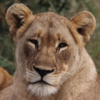
Now the story comes to the build-up towards its emotional climax, Aslan’s death and resurrection, which is surely one of the most memorable and deeply moving episodes in children’s literature (it definitely was for me as a young reader). Not really surprisingly by now, the BBC radio adaptation doesn’t do the best job of it. We simply have the Professor telling us “That evening, something seemed to be wrong with Aslan. He looked so sad, as if his heart were going to break.” Again, there’s the problem of the narrator describing something that he, as a character in the story, wasn’t there to see. It was far more effectively done in the FOTF adaptation, in which the two girls discuss between themselves how something appears to be wrong with Aslan.
The sequence where Lucy and Susan, unable to sleep, find Aslan walking away and follow him, was mostly taken from the book and quite well done — Stephen Thorne’s voice came across much better in this scene than in any of the previous ones, at least, although David Suchet also did this part really well. In fact, the FOTF version did have a bit of a clanger at the end of this sequence, where Aslan tells the girls they must stop now and not let themselves be seen. FOTF has the girls desperately begging him to stay (which we’re not told they did in the book) and David Suchet giving a near shriek of “Farewell!” as he leaves. The BBC just has the girls saying “Oh, Aslan!” between sobs and Stephen Thorne telling them “Farewell, farewell, both of you” in a much more normal-sounding voice, which worked a lot better for this scene.
However, the contrast between the two versions went the other way again as we got into the scene with the Witch’s forces tormenting Aslan under her orders, probably the most dramatic scene in the entire story. Both these adaptations kept the narrator out of it at this point and relied on the voices of the characters to tell us what was going on, but they each handled it rather differently. The FOTF version put nearly all the emphasis on the voices and sound effects of the Witch and her minions, all of which were very well done. Much of the wording was taken straight from the book, with, interestingly, a few added lines such as “Look at him now! Fancies himself a king, does he?” “Not much of a king, if you ask me!” Those particular words aren’t in the book, but they’re credibly among the things Aslan’s enemies might say at this point — and of course, they make for a good allusion to the things Jesus’ enemies said before and during his crucifixion. Whereas while the BBC version also made use of the voices of the Witch and the evil horde, a fair amount of the narration here was filled in by Susan and Lucy commenting to each other on what’s happening — and with both of them talking in such a loud and emotionally exaggerated way that one wonders how they weren’t overheard and discovered.
And then when the most terrible moment comes — “In that knowledge, despair and die” — the BBC just gives us silence after that line, and then Lucy wailing “Oh Susan, they’ve killed him! They’ve killed Aslan!” In the FOTF version, after those words from the Witch and a final additional “DIIIE!!!,” they actually had the sound effect of the impact of the knife, followed by a long, drawn-out sigh that's implicitly Aslan letting out his last breath. I’d thought, when I first heard that part, that it was a little overdone. But after hearing the BBC version, I definitely think FOTF made the better choice.
The scene with the two girls spending the night by Aslan’s body is kept reasonably short in both adaptations, but again, the FOTF one definitely does it a lot better. We hear both the girls crying, and their comments are kept fairly minimal but believable as they take the muzzle off and wipe the blood away but can’t untie the ropes. The respective narrators still stay out of it in both versions until the dawn starts to come (good choice at such an emotional moment), and in the FOTF version, as the girls continue crying, there's a quiet musical interlude to let us know time is passing. The BBC version hardly uses any background music by comparison, which is another downside of it.
Again, though, the overall main drawback of the BBC version here (and all the way through this adaptation, really), is that so much of both the scripting itself — especially for dialogue that isn’t in the book — and the delivery of the lines by the actors, is just so melodramatic that it comes across as totally cheesy, right where it’s supposed to be the most serious and deeply moving part of the story. Oddly enough, in this version we don’t hear much actual crying from the girls at this point (even though they’re supposed to do so almost the whole night), but when they speak, they keep on sounding ridiculous. This was the worst example, after the little mice have eaten away the ropes. Susan: “He looks more like himself without all those ropes.” Lucy, sounding near hysterical: “Only he’ll never be himself again!” Honestly… that’s just dreadful.
Then at last we have the most wonderful moment of the story — Aslan’s resurrection — and, predictably by now, the FOTF version does the much better job of it. They did use the narrator rather needlessly at one crucial point — describing the “great cracking, deafening noise” just before we hear it as a sound effect, which wasn’t really necessary and cuts down on the surprise of it. But after that, everything’s covered in the dialogue, and David Suchet just does BRILLIANTLY as Aslan in this scene. The only part this time where he goes rather loud and high-pitched with his voice is on “Oh, children, catch me if you can!”, which is a perfectly fine way to deliver that line, as it’s just such a joyous and wondrous moment — and then we get lots of breathless laughs from the girls and from him (sufficiently deep and resonant to sound like how one would imagine a huge Lion laughing!), which really captures the wild romp they have together, and without the narrator having to cut in and tell us about it.
Most adaptations of LWW (audio or screen) cut out that romp, which is my personal favourite scene in the entire book, so I was delighted that FOTF included it so effectively. Incidentally, Susan in this adaptation is played by Katherine Suchet, who must be either David Suchet’s daughter or else his niece, so I’m guessing that would have made recording these scenes all the more fun for them! And when Aslan decides it’s time for a roar at the end, they again use a recording of a very impressive actual lion’s roar, which crowns off this scene perfectly.
And as for the BBC’s rendition of this scene… Stephen Thorne doesn’t do too badly at delivering Aslan’s explanation about the Deeper Magic, but David Suchet definitely sounded better overall, and there was no romp included, or even a hint of it. But far worse — yes, Aslan’s roar was once again a ludicrous “Rrrrraaaaahhhhh!” from Thorne, followed by him remarking, “My, but that was good.” Ummm… no, it wasn’t.
"Now you are a lioness," said Aslan. "And now all Narnia will be renewed."
(Prince Caspian)
Topic starter
Posted : October 15, 2023 7:35 am

I've been out for awhile (been busy with a lot of stuff going on) so I haven't been posting much.
That's true, a lot of adaptations of LWW cut out the romp with Aslan and the girls following his resurrection. It might be because of time. Neither the BBC nor the Walden had enough time span to able to keep it in there (the BBC would've made it too long and the Walden probably just wanted to get on to the battle scene). Well, I think the 1979 animated adaptation (which was the first one I've watched) managed to keep it in.
I would say that both the BBC radio and Focus on the Family radio are enjoyable, each to their own advantage. Though I feel like that the Focus on the Family Radio is more superior. It's almost like watching a movie or mini-series without any visuals.
"And this is the marvel of marvels, that he called me beloved."
(Emeth, The Last Battle)

Posted : October 15, 2023 1:21 pm
There's not that much left now of the story and of either radio play. The BBC gave Aslan another slightly silly-sounding line when the time comes for them to go to the Witch’s house to free the statues: “You must ride on my back and hold onto my golden mane” — when there’s absolutely no reason for him to mention the colour of his own mane! That’s not really a serious flaw, but then almost nothing is said about the actual ride, which Lewis himself tells us was “perhaps the most wonderful thing that happened to them in Narnia” and spends a whole paragraph describing it. The FOTF version quotes part of that, giving it to the narrator, which works well and at least gives us some sense of the wonder of it.
Both versions did a good job of Aslan bringing the statues back to life, and both give us more emphasis on Tumnus coming back to life than the book does — I’ve seen at least one commentator remark that it’s a shame Lewis doesn’t give us a detailed description of that moment, or any dialogue after Lucy calls to Aslan that she’s found him. Interestingly, the BBC version has Tumnus terrified as to what to say when he realises Aslan is there, and Aslan replies: “Nothing needs to be said. The past is dead and I am alive. As are you, Son of the Woods.” That’s one of the more effective of the added lines in the BBC’s scripting, although it could be pointed out that Tumnus wouldn’t have known that Aslan himself had died and been resurrected. But it does bring out the Christian message of the story very well, and it’s something that’s a good reminder for any of us who need forgiving (and who doesn’t?) in this world too.
Interestingly, although both versions included the stone lion who got mocked by Edmund earlier and was the first creature brought back to life by Aslan, neither of them included the sequence in the book where that other lion runs about excitedly pointing out to everyone that Aslan said “Us Lions”, until Aslan loads him up to carry a whole lot of smaller creatures. It’s not even a very important episode, let alone essential to the story, but it always gave me a laugh as a child! I don’t think it’s been included in any of the screen adaptations either, and I’m guessing one of the reasons for it being left out is not wanting to detract from Aslan as “THE” Lion in this story. Certainly Lewis himself didn’t include any other Talking Lions in any of the other books, only non-talking ones such as the one whose skin plays a crucial role in the plot of The Last Battle.
The last really dramatic event in the story is the Witch’s death as Aslan and the new army join the Battle of Beruna. Once again, a huge contrast between the two radio adaptations, and no prizes for guessing which was very much better done.
The FOTF version: “Aslan! It can’t be… No!!!” *ROAR* [yet another real lion recording]
The BBC version: “No! I am not dead. Rrrrraaaaahhhhh! [Stephen Thorne doing another totally ridiculous “roar” again] I am alive, and I have come to take back what is mine.” “No, no!”... In all honesty, that was one of the most terribly scripted parts of this adaptation that had so many terribly scripted parts.
There was one slightly silly line for the narrator after the coronation (very well done) in the FOTF version: “And now, as you see, this story is nearly at an end.” Well, no, actually, since it’s an audio play, we can’t “see” anything of the kind, not in the same way we can see that a book is nearly finished! Unless, of course, we’re listening to it on a CD player and we note that it’s now on track 8 out of 9, but that’s not how it was originally designed to be heard. That line is in fact a slightly shortened version of Lewis’s remark as narrator in the last few pages of the book: “And now, as you see, this story is nearly (but not quite) at an end” — which would have worked better for the radio version if they’d cut out the “as you see” rather than the “but not quite”! But that’s only a minor slip in an adaptation that was truly brilliant throughout (unlike some).
The adult Pevensies’ voices are very well done in the FOTF version — I’ve checked and the same actors are used for adult Susan, Edmund and Lucy in The Horse and His Boy, which is good to know. There’s also an excellent transition as they walk beyond the lamp-post, as the four adults’ various remarks start sounding slightly higher-pitched as they speak, until it’s the four child actors speaking again — I don’t think they used any special effects there, just very good voice acting.
In complete contrast, the BBC version didn’t even bother to get voice actors to do the four adult Pevensies — that entire sequence is just covered in narrative format by the Professor, without any of the Kings and Queens speaking at all. Budgetary constraints, maybe??
I was wondering why they couldn’t simply have used the actors they were planning to use in The Horse and His Boy, but I just checked and while the BBC versions of MN and LWW were first broadcast in 1988, HHB wasn’t broadcast until 1994. (And then PC was broadcast in 1995, so they were still going in the chronological order of the books.) So there was presumably a big gap between recording them — perhaps it wasn’t originally certain whether the series would continue beyond the first two productions. Fair enough, but it makes for one final disappointment in an adaptation that, for me at least, fell flat such a stunning number of times that there was really no way I could find it enjoyable.
There really isn’t much more I can say about either of them, so here are my final ratings:
Focus on the Family: 9 out of 10
BBC Radio: 3 out of 10
I haven't listened to either radio adaptation of The Horse and His Boy before, so I'm looking forward to hearing what both of those will be like — especially after such a huge difference in quality between the first and second plays in the BBC series!
"Now you are a lioness," said Aslan. "And now all Narnia will be renewed."
(Prince Caspian)

Thanks so much for chronicaling this Courtenay! I'm really enjoying reading your thoughts. It wouldn't really be possible for me to evaluate them fairly myself since FotF practically IS Narnia for me. I listened to them waaaaaaay more than I read the books. HHB is my absolute favorite, so I really can't wait for your thoughts on it.
A comment, you mentioned there was no indication that the Turkish delight was enchanted, but I think it's strongly implied. He eats it, wants more, thinks about it, Lucy tells him he looks awful, the beaver says he's "been with the witch and eaten her food," and the healing at the end seems partly healing from those effects, at least to me.

Posted : October 30, 2023 6:31 pm
Courtenay liked
Thanks, @anfinwen! I will be making a start on HHB soon (and intend to listen to the FOTF version first), so I'm looking forward to finding out what I think as well. What has surprised me most so far is that I had such opposite reactions to the two versions of the first two stories — in one case it was the BBC version that hit a lot more of the right notes for me (though the FOTF version of MN would have been mostly fine with me if only David Suchet hadn't made Aslan sound so silly so many times), and then with LWW, it was the FOTF version that had me just about enchanted and the BBC that had me constantly wondering "What were they thinking?!" 


"Now you are a lioness," said Aslan. "And now all Narnia will be renewed."
(Prince Caspian)
Topic starter
Posted : October 30, 2023 10:11 pm
I wonder if some people would have liked David Suchet’s voice of Aslan in the 1990’s or longer ago than that time. Today people have a different attitude toward exaggerating characters. They often don’t like Barbara Kellerman’s White Witch in the BBC television production because the exaggeration is too much, and it is much the same with David Suchet’s Aslan voice. It may have been different during that time (the 1980’s and 1990’s or a few years after that) when a exaggerated voice was more acceptable. In decades before that it was quite common to have such voices in children’s programs whereas today the overacting may be looked at as talking down to children. I guess that today’s adults want to sound more sophisticated in speaking to children. That may explain David Suchet’s treatment of Aslan as a character in his voice acting. Most likely today’s actors wouldn’t portray Aslan in that manner. I can’t have an opinion on the BBC Aslan radio character since I haven’t heard it except for a few short clips, which isn’t enough for me to judge.
Posted : November 3, 2023 5:07 am
@narnian78 I really don't know — it would be interesting to hear from anyone who listened to the FOTF productions when they were originally broadcast, whether people thought David Suchet's performance as Aslan sounded like what they would have expected at the time. That said, I was a viewer in the target age range when the BBC TV productions of Narnia were first broadcast, and Barbara Kellerman came across like a pantomime villain even then — but that didn't really stand out, because the entire show was done in such a hokey-yet-endearing way. And the thing is, they did make Aslan believable enough, which is the most important aspect of Narnia to get right — he looked a lot more realistic than any of the other animal characters (even if he couldn't lip-sync!), and Ronald Pickup did a good job of his voice. Whereas David Suchet at times does sound like a very credible Aslan, and then at other times he doesn't! It almost comes across as if he sometimes got over-excited and forgot what character he was playing — that's how much difference there is between some of his lines. I don't know if he's ever commented publicly about his voice role as Aslan and why he did it the way he did and whether he would change anything if he did it again. It'd be really interesting to know! He's written a fascinating book on Poirot and how he interpreted that role, which is by far his most famous — here in the UK, David Suchet pretty much IS Poirot in most people's minds. But the FOTF radio plays of Narnia are, as far as I'm aware, virtually unknown over here, and I'm not aware of him making any comments on them.
EDIT: I forgot to add a point I was intending to make above — that while David Suchet's performance as Aslan is hammed up too much at times, none of the other voice actors in the FOTF productions seem to have played their own roles in a noticeably exaggerated way. That to me suggests that the producers weren't aiming for or encouraging that kind of effect overall, whether or not it was fashionable in adaptations of children's books at the time. So I assume it was Suchet's own choice of interpretation, for whatever reasons, rather than him being told to play Aslan in that particular way. But I don't know for sure.
"Now you are a lioness," said Aslan. "And now all Narnia will be renewed."
(Prince Caspian)
Topic starter
Posted : November 3, 2023 11:38 am
Narnian78 liked
Is the BBC radio version still broadcast on the radio today? I remember not too long ago hearing the Focus on the Family Narnia on the Moody radio station so I guess that radio stations will still take a chance on broadcasting audio plays. I think there would still be a audience for it just like Big Finish offers dramas based on Dr. Who and other long ago programs. I think there still people who like audio versions of stories without being distracted by too much technology on a screen. It’s something old fashioned that some people will still like. 🙂
Posted : November 5, 2023 3:55 am
Is the BBC radio version still broadcast on the radio today?
No, I don't think so. The BBC does still sometimes do radio plays and serialised stories (not to mention The Archers, the world's longest-running radio soap opera!), but I don't think they usually do re-runs of past material. I certainly haven't heard of the Narnia radio series ever being re-broadcast, especially as it's been available on CD for a long time, for anyone who wants to listen to it at their leisure. It might have been aired more than once in its first few years, but I doubt they'd play it again now, it being such old material. I don't think the Narnia adaptation was ever wildly popular even when it was first broadcast — it certainly hasn't come anywhere near attaining "cult classic" status like Doctor Who or The Hitchhiker's Guide to the Galaxy, put it that way! 
"Now you are a lioness," said Aslan. "And now all Narnia will be renewed."
(Prince Caspian)
Topic starter
Posted : November 5, 2023 2:44 pm
Narnian78 liked
I think I would give the Focus on the Family Narnia a rating of 8 / 10. It is true that I kind of disliked the voice of Aslan at first as it was performed by David Suchet, and it still is difficult for listening. But with listening to the dramas several times I found the voice a little less bothersome. Also, there are many moments of excellence in the production such as its general faithfulness to the book and also the fine performance of the other actors. In fact the dramas may be the best performance of Narnia that I have heard so far. There may be some theater performances which equal it, but I haven’t attended them so I couldn’t say if they are better. I can’t compare it to the BBC radio version since I have never heard it. Whether something is popular or not doesn’t have any influence on my rating. Focus on the Family Narnia may not be definitive, but it does offer something very good for those who have read the books. 🙂
Posted : November 7, 2023 8:50 pm

I listened to the BBC Tales of Narnia years ago and mostly liked it. The issues you're hearing with the adaptation where dialogue or monologue is taking the place of a narrator unfortunately goes through the whole series. Occasionally the adaptation choices made work okay, but mostly it would've been better if they just went all in on a narrator like FOTF.
My single biggest issue was FOTF's version is Suchet. He's fine in most of it, but I never really warmed to him. Other places his line reading choices are so bad that it made me want to just dump the whole FOTF set. I don't remember if you noted it, but Stephen Thorne from the BBC radio Tales of Narnia is the same actor who did Aslan in the cartoon. He's much more subdued in radio ones, though, which works a lot better. I liked him a lot, which is probably why I usually opt for BBC's versions whenever I feel like listening to any of them again. I generally prefer the vocal performances of the BBC actors, although I much prefer FOTF's voice for Eustace.
I think my favorite from FOTF is Voyage of the Dawn Treader. I really liked the ending with Caspian. My BBC favorites were Horse and His Boy and Last Battle. I really liked Martin Jarvis and I thought the scene where Shasta meets Aslan was excellent with Stephen Thorne. The Last Battle's script/adaptation has a lot of issues, but I still like it because of the voices (not Eustace): Particulalry Paul Rhys as Tirian and John Sessions as Shift.
Posted : November 15, 2023 6:39 pm
Courtenay liked
@justin_orman Hi Justin — really interesting to hear your thoughts, from someone who's familiar with both radio productions! 
I did know Stephen Thorne also did Aslan's voice in the cartoon version of LWW. Mostly he's very good in the BBC radio adaptations so far, at least in the way he delivers his spoken lines — it's the poor scripting and the incredibly tacky "Rrrrraaaaahhhhh!" noises that are the big let-down. But he probably didn't have much of a say in any of that.
I'm now starting on the FOTF version of The Horse and His Boy, currently about 1/3 of the way through. So far it is excellent and I have no serious gripes — although Aslan hasn't come in as a speaking character yet, so I'll reserve judgment until I hear what David Suchet does with him this time...
"Now you are a lioness," said Aslan. "And now all Narnia will be renewed."
(Prince Caspian)
Topic starter
Posted : November 16, 2023 12:56 am
Anfinwen and Justin_Orman liked

Hey, just popping back to explain something. I know everyone's forgotten about this by now, so it's weird to bring it up again but I think you deserve an explanation.
A while back, I responded negatively to Courtenay's suggestion that the script for the Radio Theatre adaptation of The Lion, the Witch and the Wardrobe reflected a Calvinist/Presbyterian theology as opposed to C. S. Lewis's more Anglican worldview. I think she was surprised by how snippy I was. Well, the thing is I remember a long, long time ago on the old, old Narniaweb forum (that's unavailable to read now) a Narniawebber actually criticized a radio show by Focus on the Family for not being Presbyterian. Another Narniawebber pointed out that there were other episodes of the same show, ones written by different writers, that were a lot more Presbyterian friendly. (It's amazing the weird things you remember when you've followed this forum for a long time.  ) So I feel like it's a stereotype of FOTF that you have to belong to that denomination to write for them. It seems like you mostly just have to be Protestant.
There are other Radio Theatre adaptations which I'd definitely describe as reflecting Focus on the Family's worldview rather than that of the original author, but except for maybe toning down some violence and language, they don't really do that with their Narnia adaptations. I feel they deserve credit for that.
Anyway, I'll be interested to read your reviews of both the BBC and the FOTF radio adaptations of The Horse and his Boy. I was surprised that you felt having the professor narrate the BBC LWW didn't make sense since he seems like the character closest to C. S. Lewis, but you made good arguments. I'm really interested in what you write about the BBC Last Battle since I remember hearing that one played around with the story a lot.
For better or worse-for who knows what may unfold from a chrysalis?-hope was left behind.
-The God Beneath the Sea by Leon Garfield & Edward Blishen check out my new blog!
Posted : November 21, 2023 3:52 pm
A while back, I responded negatively to Courtenay's suggestion that the script for the Radio Theatre adaptation of The Lion, the Witch and the Wardrobe reflected a Calvinist/Presbyterian theology as opposed to C. S. Lewis's more Anglican worldview.
Gosh, I'd almost forgotten that myself, and I would now say I was almost certainly overdoing things by analysing it that way. It had to do with the fact that the FOTF version of LWW didn't have the Witch behaving threateningly towards Edmund at first (which she does in the book, and he's terrified) and didn't include any mention of the Turkish Delight being magically addictive. I was simply wondering if there was any theological reason for apparently making Edmund more personally at fault for his own sins. But I suspected afterwards that I was probably reading too much into it, especially when it was confirmed that none of the other adaptations mention the addictive powers of the Witch's Turkish Delight either!
Regardless, I wasn't meaning to cause any kind of debate and I'm relieved it wasn't taken personally. Though for clarification, I don't think I mentioned Presbyterianism at all. That's a denomination I know virtually nothing about, apart from the fact that it originated in Scotland!!
There are other Radio Theatre adaptations which I'd definitely describe as reflecting Focus on the Family's worldview rather than that of the original author, but except for maybe toning down some violence and language, they don't really do that with their Narnia adaptations. I feel they deserve credit for that.
As far as I've noticed with the FOTF adaptations I've listened to so far, there have been no substantial changes to the plots at all, which indeed is hugely to their credit — almost certainly the most faithful adaptations of the Narnia books that have ever been made so far. The only major change I've picked up — and it doesn't affect the overall plot — is in VDT, where it's specifically stated that Eustace-the-dragon decides to stay on the island forever so that the others can go on with the quest without having to worry about what to do with him. I guess someone decided there needed to be a real sign of repentance and a change of heart in him before he could be worthy of Aslan's grace. But that's off topic for the moment, as I'm not up to that story yet! (I listened to the FOTF version of it a few years ago and I remember that standing out as being significantly different from the book, which virtually nothing else in it was.)
Anyway, I'll be interested to read your reviews of both the BBC and the FOTF radio adaptations of The Horse and his Boy. I was surprised that you felt having the professor narrate the BBC LWW didn't make sense since he seems like the character closest to C. S. Lewis, but you made good arguments.
That's a decent "out-of-universe" argument — this character seems to be the closest thing we have to an authorial self-insert, so it makes sense for him to be the narrator. I was looking at it from the "in-universe" perspective, though — this character didn't participate in or even observe the actual adventure, so having him recount it in detail, especially the children's deepest thoughts and feelings, doesn't make sense and makes the whole thing feel artificial to me. (Whereas having the same character as the narrator in MN worked very well, as he was a direct participant in nearly everything that happened.)
I'm really interested in what you write about the BBC Last Battle since I remember hearing that one played around with the story a lot.
Ooer, it might take me quite a while to get to that one!  I'm stalling with HHB at the moment, partly because I'm having a few days away from home and don't have the CDs with me. And even when I'm at home, I don't always have (or make) the time to do nothing but sit and listen to radio plays and type up extensive notes on them! But it's a very interesting project and I will definitely get there, bit by bit...
"Now you are a lioness," said Aslan. "And now all Narnia will be renewed."
(Prince Caspian)
Topic starter
Posted : November 21, 2023 4:51 pm
I didn’t notice any denominational bias in the Focus on the Family Narnia. The dramas are adaptations of books by C.S. Lewis, who did not have any prejudice against other denominations (at least not in his own writing) against other Christians or different backgrounds even though he might not have entirely agreed with their worldviews. My own church is a member of a Calvinist denomination, and the people in its churches have much appreciation for C. S. Lewis’s works. The Focus on the Family organization has a similar background, but I don’t think they would have allowed their their personal differences in beliefs to enter into a radio drama based on a book by C. S. Lewis. Also, I don’t think the Narnia books have any ideas from doctrines specifically of the Anglican Church other than those that are generally endorsed by all Christians.
Posted : November 23, 2023 3:09 am
Courtenay liked